Showing posts with label elementary. Show all posts
16 May 2017
04 May 2017
Gamify Your Classroom!
At this point of the year, I think it's safe to say the kids are losing interest in being in school and teachers are pulling out all the stops to keep kids motivated and engaged!
Between state standardized testing, end-of-the-year evaluations, and the weather finally improving in some parts of the world, student engagement is probably pretty weak in your class...am I right? I'll bet most of you are running on fumes, too...I'll admit that I am!
Well, here's my secret to re-energizing yourself, your students, and your curriculum...
Between state standardized testing, end-of-the-year evaluations, and the weather finally improving in some parts of the world, student engagement is probably pretty weak in your class...am I right? I'll bet most of you are running on fumes, too...I'll admit that I am!
Well, here's my secret to re-energizing yourself, your students, and your curriculum...
gamify (ˈɡeɪmɪˌfaɪ)
What does "gamifying" look like in a classroom? It can look a few different ways! Read on...
Low- or No-Tech: I love using Task Cards with my students as a way to up the fun while learning! Task cards require no technology at all...well, once you've printed them! I use task cards in a few different ways, depending on my mood:)
- Play Scoot! "Scoot" is a fun way to get kids moving. I tape as many task cards as I have students around the room or on desks. Each child gets an answer form, then they move from one card to the next in number order and responds to each task card on their answer sheet.
| Scoot! |
- Pass the Cards! In this version, the kids stay at their seats, but the cards move. Once a child answers the card's question, they pass it to the person next to them until they've responded to all the cards. This works especially well for task cards with multiple choice or short answer questions.
| Poetry Vocabulary Task Cards |
- Scramble! I give students parts of a sentence that they have to unscramble to create a complete, correctly assembled sentence with proper punctuation. You can find this game (in a non-holiday version) "The Great Clause Race" in my TpT store for only $1!
| The Great Clause Race |
- Around the World! This is the classic game we all played as kids in school, usually with multiplication flash cards. 2 kids stand up next to each other, the teacher reads a question from the card, and the first child to shout out the answer moves to the next opponent.
- Team Challenge! This may be my favorite! I make 5-6 sets of the same task cards. Rather than giving students an answer sheet, I put them in small groups and have them race against other groups to sort them. (This doesn't work for all types of task cards, though! I especially like to do this with parts of speech, three types of verbs, verbals or other grammar topics.) This variation requires kids to work together and gets their competitive juices flowing. It's great support for weaker students and they don't feel as intimidated.
| Task Cards |
- Minute to Win It! This is also a great team variation. I separate kids into teams and create challenges like "find all the cards with a noun underlined, then be the first to clothespin them together", or "be the first to alphabetize the words", or even "use all the sentences containing an infinitive to build a house of cards". My middle schoolers LOVE playing Minute to Win It!
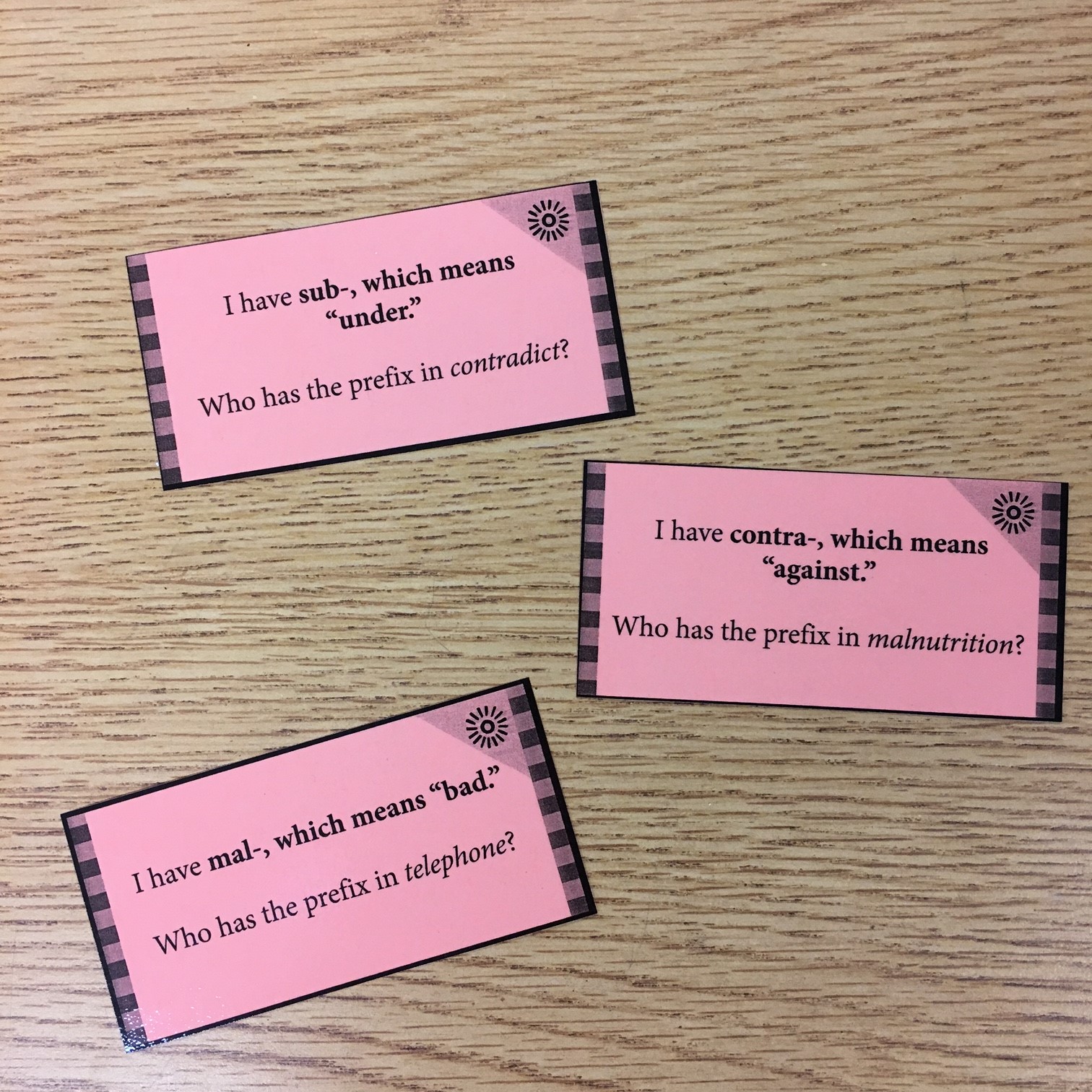
- I Have, Who Has? You can't do this with basic task cards, but you can find specific "I have, who has?" cards on TpT, at teacher stores, or you can make your own. This is a great game to calm kids down and really make them focus. Each student gets a card or two (you have to pass out all the cards in the set for the game to work and come full circle). One card will say "start"-that student begins by reading his card. The rest of the students have to listen to the speaker, then look at their card to see if they have what the speaker is looking for. For example, card one may say, "Who has the prefix that means 'under'?" The student holding the card that says 'sub-' responds, "I have 'sub-', who has the prefix that means 'to do again'?" and so on until one student is left with the "stop" card. When I taught elementary, I'd often end my day with this game while we waited for buses, or right after lunch recess to calm students down and get them re-focused.
Tech Required: There are SO MANY amazing, interactive game programs designed just for schools! If you haven't tried any, please do! Here are a few of my favorites:
- Quizlet and Quizlet Live! I really think this is the complete package of games! It's really easy for teachers to set up an account at quizlet.com and to have his or her students join their class. Once you've got an account, you can either create a set of flashcards, or use a set that another teacher has already posted. Now that you've got a set of flashcards created, the FUN begins! Kids can log in at anytime and use the flashcards in a variety of ways-as normal flashcards, as a matching game, a race between players, and my personal favorite in-class game-Quizlet Live! Quizlet Live allows a teacher to break a class into teams that have to work together-YES! TOGETHER!- to match up terms and definitions. They have to work together because each student only has a few of the answers. As a team, they all see the definition, but only one teammate has the answer, so one kid can't do all the work! Watch a demo here: https://vimeo.com/161809345. Trust me your class will LOVE this! Quizlet is something kids can do on their own at home to study, and it even has an option for teachers to create a variety of tests to print off. Quizlet is super student and teacher friendly!
- Kahoot! This is actually my least favorite online game, but kids like it. Kahoot allows you to create your own or use sets made by other teachers, just like Quizlet. Unlike Quizlet, Kahoot is a multiple choice game. Here's what I don't love. The question is only visible on the teacher's projected screen, but the answers are only on a student's device. That makes for a lot of looking up and down, and honestly some frustration visually. This game is usually played with all students playing for themselves against the rest of the class, which is great for bright, competitive kids with quick fingers, but can be frustrating for slow-processing kids. The newest update does allow for teams, which I think is an improvement to keep all kids engaged.
- Quizizz! Quizizz is my latest find and current favorite. Quizizz is similar to Kahoot, in that it lets you create or use sets of multiple choice questions made by other teachers. However, the big difference is that each student sees the question and answers on their own screen and that it is student-paced. In Kahoot, the whole class has to wait for all students to answer (or the teacher can set a time limit) before moving on to the next question. In Quizizz, as soon as a student answers a question, the next question pops up on their screen and they can move on. It takes the pressure off slower students, and eliminates boring wait time for quicker students. There is still a level of competition involved because the teacher can post a leaderboard and a winner can be named, but this is an option, not a necessity. The other fun thing about Quizizz, is that after each question, a meme pops up congratulating them or encouraging them. There are pre-loaded memes, or teachers can create their own. The kids and I think they are pretty funny!
- Nearpod! Now, Nearpod isn't as much of a game, as the others, but it is still a fun teaching tool. I wrote a blog post about it last year, if you want a more in-depth review. Since that blog, they've made updates which I think make it more fun. With Nearpod, you can upload your own powerpoint or google slide presentations and add student activities to the slide show. When you present, each student sees your slide show on their own device while you project it. Between slides, you can insert activities such as multiple choice questions, polls, short answer responses, drawing responses, true/false questions, etc. The students answer the question or do the activity on their device, then all responses pop up on the teacher's screen. It's a great way to quickly insert formative assessments in a presentation, and it keeps kids' attention and gets students actively learning during what would otherwise be a lecture-based lesson. Most of Nearpod's functionality is free, if you upload your own slide shows. However, there is a paid option that allows you more choice of activities, and the ability to purchase already created Nearpod presentations.
If you are looking for ways to keep student engagement high right up to the end of the year, I hope you try out some of these activities! Do you have other ideas to gamify a classroom? Let me know by commenting below!
30 March 2017
10 Tips for Helping BIG KIDS Manage Themselves at SCHOOL
I have a 5th grader and an 8th grader at home. I just received letters from both the HIGH SCHOOL and MIDDLE SCHOOL informing me that I now, officially, have BIG kids! How will I not have any little kids anymore? My mommy heart is crying crocodile tears, but my mommy brain is spinning with thoughts of "how in the world will these two handle the new responsibilities of middle and high school?"
So, instead of looking at baby pictures with teary eyes and a glass of chardonnay, I stepped out of my mommy-self and put on my teacher-thinking-cap. I work with big kids every day. I help big kids get organized in my classroom. I advise parents JUST LIKE ME on how to help their kids adjust to middle school. Plus, my son has survived middle school with great grades and minimal drama, so I must have done something right. So, I sat down and made a list. (Doesn't everything seem easier to handle when you start with a list?!?) Actually, I made 2 lists...one for teachers at school and one for parents at home! I'll share each list in a separate blog post :)
TOP 10 Tips for helping BIG KIDS Manage Themselves at SCHOOL
1. Each student should have a dedicated homework folder. This folder goes to EVERY class and only work that needs to travel between school and home goes in it. Now there is no need for kids dragging 50-pound backpacks home or forgetting something important in their locker!2. Teach kids to use their planner/assignment book. Spend time at the beginning of the year teaching this skill, then follow up throughout the year with occasional check ups. Reward those students with fully filled-in books.
3. Use Google Classroom! It is SO easy to set up and manage. You can post assigments, a calendar, e-copies of work, online textbook links, video links, just about anything you can think of. This is a life-saving resource for kids who forget papers...all they need is an internet connection and device!
4.Use remind.com to make parent/student communication quick and easy! Just sign up for an account, then you can send texts to remind parents and students of upcoming due dates, tests, etc.
5. Create a team blog to use as an online assignment book. Our 6th grade team all has "ownership" of a blog and we all post our daily assignments in one place. This is especially helpful for students who struggle to fill in their planners. Google Sites and Blogger are really easy to set up and use!
6. Have a box of extra copies in your classroom. Put a file folder in for each day of the month. Toss in a few extra copies of papers passed out each day for absent or absent-minded students. If today is March 30, the papers go in file #30.
7. Don't let important materials leave the room! I like to have ISN/Journal storage bins in my classroom. I also don't let textbooks leave...students have online textbooks for home.
8. Offer a "Get Out of Jail Free" card! Let kids know that we understand mistakes happen and occasionally we are all forgetful. I like to give out one or two homework passes per quarter and my team uses "oops" coupons which students can attach to late work for no point loss.
9. Reward GREAT behavior! Our school is a PBIS school and we give coupons to students who are caught being good. Then, each teacher has a "store" in their classroom where students can redeem their coupons for candy, late work passes, leave class early passes, sit in the teacher's seat reward, etc. Students really love these rewards and it helps keep them on task!
10. Offer help, but set boundaries. I like to open my class for lunch one or two days a week to students who have questions, need extra help, or need to make up work after an absence. I also make myself available via e-mail. However, many students (and parents) try to overuse this help, so make sure you set boundaries about how quickly parents should expect a response from e-mail, how many times a student can come in at lunch, or how late in the day is acceptable to send e-mails about homework.
Have questions about how I organize things? Have other ideas to help students become more responsible? I'd love to hear what you do! Comment below or e-mail me at teachwithmrsb@gmail.com!
12 July 2016
Help Students Become Comma Rock Stars!
I just found out that I will be teaching 6th grade this year! I taught one section of 6th grade my first year in middle school, and was just trying to keep myself one step ahead of the kids while I learned new curriculum! Now that I'm feeling confident with my 8th graders and 8th grade curriculum, this is a great time to dive back into 6th grade, too!
So, guess what have I been up to this week? CREATING new activities!
The major grammar focus in 6th grade is commas. Commas can be so confusing to kids because there are SO MANY rules about when to use them! Commas are either over-used or under-used by novice writers...some people sprinkle them all over their work, and others avoid using them at all costs! I've always been pretty confident in my comma usage - I was taught to use a comma anytime you take a breath - I still think about that when I write, but that was pretty much my entire education regarding commas. It wasn't until I began teaching with a heavy focus on grammar that I really researched ALL.THE.RULES. I never realized how many different ways the cute little comma is used! Nor did I realize that standards involving comma usage are found in all grades (1-10) in the Common Core State Standards! That means that every single school year, students are being explicitly taught how to use commas in their writing! That's awesome! Our students will be comma rock stars by the time they hit high school and never misuse that cute little comma, right?
WRONG! Even though teachers are teaching commas starting in 1st grade, 8th graders don't always know when and when not to use commas.
Now that I'm teaching 6th grade, I've got the time to really dig deep into commas with my students (and hope I won't have to spend as much time re-teaching commas with them as 8th graders!). This month, I've been busy creating activities to help me review and teach commas. The first thing I did is create anchor charts to hang in my room to answer this question:
I created one poster for each major comma rule (10 in all) ranging from 1st grade standards on up through 8th grade standards. I know it seems odd to be reviewing 1st grade skills with 6th graders, but believe me, they need reminders! (Of course, I won't tell them which are 1st grade standards, like using commas in dates and lists, but it sure doesn't hurt to review!) No matter what grade you teach, you can use some or all of these posters in your room! You can see samples of all 10 posters in the product preview in my TpT Store.
Here's a sample of a poster for a 6th grade standard:
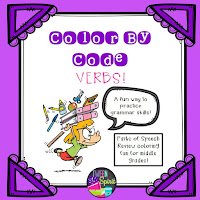
In the process, I discovered a super-cool new clip artist who calls herself "Mae Hates Mondays" and draws big-kid friendly clips. Even her store name is PERFECT for middle schoolers! I'm loving her clip art teens so much that I had to make another picture with them! So I made a third Color By Code activity to help students identify simple sentences, compound sentences, complex sentences, compound-complex sentences, and sentence fragments.
I mean how great are these characters???
So now, I'm ready to head back to school to teach these 6th graders how to use commas like rock stars! Click on the pictures of each product to learn more! I hope you find them useful, too!
30 June 2016
Stop the Summer Slide!
Every parent worries about the dreaded SUMMER SLIDE! How can we keep our kids learning over the summer without burning them out or driving ourselves crazy?!? Summer camps are great, and so are workbook pages...but GAMES and COLORING are even better! I thought I'd share a few ideas I have for elementary and middle school kids today!
Now that I'm a middle school teacher, I don't often create or post things for elementary students anymore. However, one of my FAVORITE creations is my list of math games you can play at home with manipulatives most people already have at home!
You can click on the picture below to check it out!
This product has saved teachers a lot of time and they've gotten big thanks from parents who are using these tips! Here are some product reviews:
You don't need to be a teacher to love these activities! I have played all of these games at home with my kids and they don't even realize they are practicing math skills :)
Here are 2 FREEBIES for the older kids! Many middle schoolers struggle with the summer slide, too! We can't forget about them...especially since curriculum moves SO fast in middle school.
These free products help kiddos review the 4 types of sentences and the different types of nouns. Most ELA teachers in middle school do a super fast review of these topics the first week of school, but they really expect kids to have at least a general idea of these basic ELA topics when they come in. These FREEBIES are a great way to give your big kids a head start right before heading back to school! Click on the pictures to grab these from my store today!
Hopefully, you will be able to stave off the dreaded summer slide with help from these activities! If you are looking for more great FREEBIES, check out the "Summer Slide Linky" going on at The Teaching Bug's blog!
Now that I'm a middle school teacher, I don't often create or post things for elementary students anymore. However, one of my FAVORITE creations is my list of math games you can play at home with manipulatives most people already have at home!
You can click on the picture below to check it out!
This product has saved teachers a lot of time and they've gotten big thanks from parents who are using these tips! Here are some product reviews:
"Perfect to give to parents looking for ideas at home!"
"Thank you. The parents and kids loved the games. It helped to enhance my open house night."
"Great resouce. I used it at our Math Night and it was very well received. Thank you!"
You don't need to be a teacher to love these activities! I have played all of these games at home with my kids and they don't even realize they are practicing math skills :)Here are 2 FREEBIES for the older kids! Many middle schoolers struggle with the summer slide, too! We can't forget about them...especially since curriculum moves SO fast in middle school.
These free products help kiddos review the 4 types of sentences and the different types of nouns. Most ELA teachers in middle school do a super fast review of these topics the first week of school, but they really expect kids to have at least a general idea of these basic ELA topics when they come in. These FREEBIES are a great way to give your big kids a head start right before heading back to school! Click on the pictures to grab these from my store today!
Hopefully, you will be able to stave off the dreaded summer slide with help from these activities! If you are looking for more great FREEBIES, check out the "Summer Slide Linky" going on at The Teaching Bug's blog!
Subscribe to:
Posts (Atom)